Thank you to everyone who attended our branch meeting on 26 February. This is a summary of key updates and actions.
Two Executive Committee Members Added

Paul Hartley has been added as our new HEMS Faculty Rep. Welcome, Paul! If you are in HEMS and need to reach out personally to BU UCU, you can contact Paul.

During the Branch Meeting we also voted overwhelmingly to accept Joe McMullen as our new BU UCU Vice Chair. Many thanks to Joe for stepping up!
Casework – How to Get One-to-One Support
Members sometimes need individual advice or representation. In union terms, this is called “casework”.
If you would like a one-to-one meeting with a BU UCU representative, the first step is to complete a Casework Proforma. This is available on our branch blog under “Information for Members” and takes you to a secure online form.
The information you provide is stored in a confidential folder and is only accessed by trained caseworkers.
Please complete the form as fully as possible. The more detail you can provide at the outset, the more effectively and efficiently we can support you. It allows caseworkers to understand the issue clearly before meeting with you and ensures you receive timely, focused advice.
Casework is confidential, member-led, and there to protect your rights at work. If you are unsure whether your situation requires casework, you can contact the branch for initial guidance.
Trade Dispute Outcome
Members have voted to accept the Proposed Joint Statement between Bournemouth University and UCU to resolve the trade dispute.
86 members voted (25% turnout):
Accept: 74 (86%)
Reject: 12 (14%)
The agreement includes:
- A commitment to no further compulsory redundancies
- An agreed approach to future consultation on redundancies or changes to working practices
- Agreement on the policy framework to be used in any future restructure
- A strengthened approach to Equality Impact Assessments at a formative stage
- A commitment to reasonable workload expectations aligned with contracts
- Compliance with collective agreements and established negotiation procedures
Workload Planning (WLP) – Serious Concerns
We devoted substantial time to the University’s proposed new Workload Planning model.
Our position is clear: workload planning has historically been negotiated at BU, and we expect that practice to continue.
At a special JCNC meeting on 25 February, we raised members’ concerns and requested:
- A longer consultation period
- Additional research time for Bands 1 and 2
- Clear and transparent criteria for band allocation
- Proper consideration of equality and diversity implications
- Multi-year band allocations (2–3 years) to enable research planning
- Greater flexibility to reflect disciplinary diversity
Key Issues Identified
The proposal would:
- Reduce baseline research time from 400 hours to 175 hours for all staff
- Introduce competitive annual applications for research “bands”
- Place annual tariff decisions entirely with UET
- Remove negotiated agreement from workload allocations
- Centralise power away from staff and towards senior management
The application process for research bands has not been transparently defined. We understand panels may include REF leaders and senior management, with decisions based on institutional priorities. Members have raised concerns about transparency, fairness, and equality implications.
We also raised widespread concerns about inadequate time allocations for:
- Teaching preparation and first-time unit delivery
- Level leadership and programme review
- Open days and outreach
- Academic offences panels
- QEAG, validation and revalidation
- Field trips, lab-based teaching, placements
- Professional body liaison
- REF and research mentoring roles
The proposal also risks increasing invisible work through “bucketed” hours and creating additional managerial burdens across the institution.
If implemented as drafted, this would represent a significant shift in governance and workload control.
Member Survey
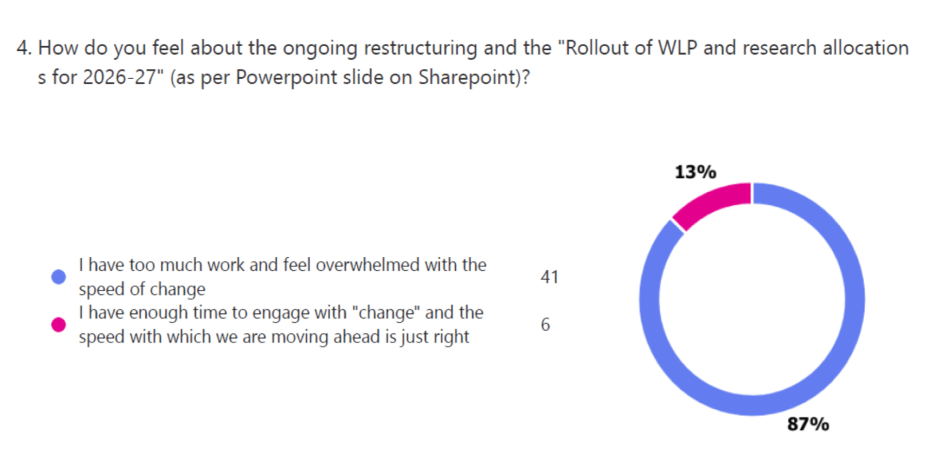
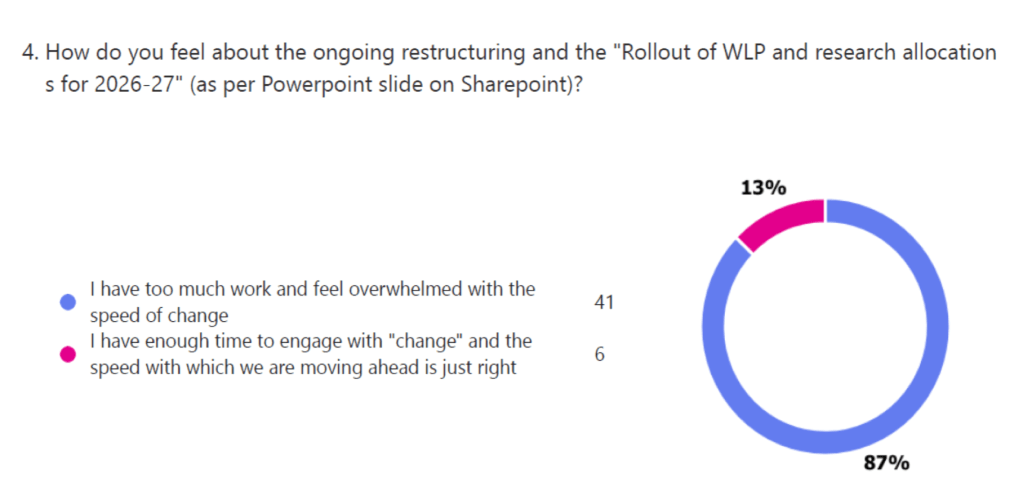
Our WLP survey opened on 23 February and received 47 responses within 24 hours. A key finding was that 87% of respondents felt overwhelmed at the speed of policy and governance change in the university, without sufficient time in their workloads to consider the changes and feed back on them.
3B and Academic Services Restructuring
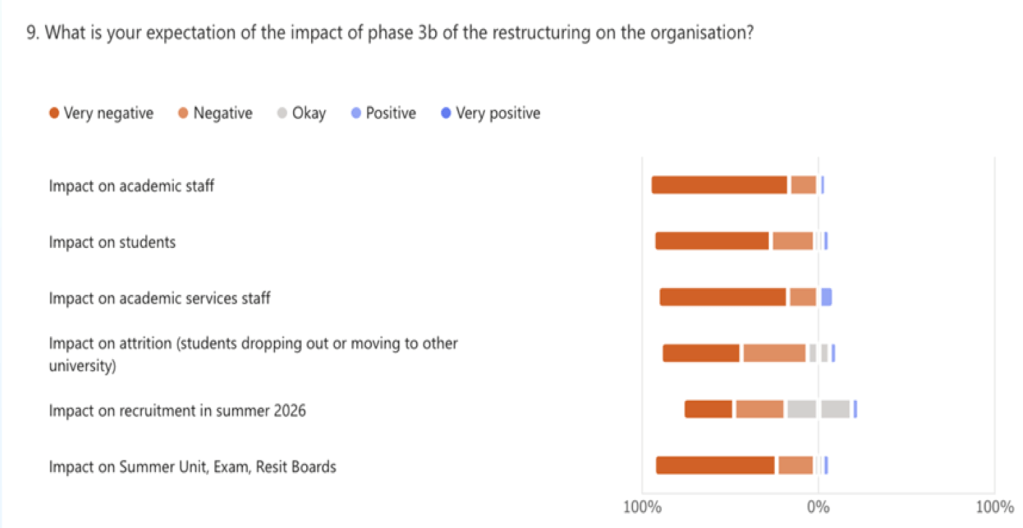
We have formally recommended that the restructuring of Academic Services be postponed until 2027 in order to:
- Protect continuation and recruitment in 2026
- Prevent further overwork and unpaid overtime
- Ensure students retain a single, knowledgeable PSO contact
PRIEPs – Important
During AOB, members reported being told how PRIEPs (forgive your webwriter, I’ve already lost what this 9,999,999th BU acronym stands for; it’s the research plans we have to submit to be graced with any research hours in their world’s most bestest plan ever) are being assessed and reviewed, including informal guidance about how colleagues should complete them.
If you have been advised by your manager on how to frame or complete your PRIEP, or if you have been given information about how PRIEPs are being reviewed, please use the general reporting form to let us know.
We are gathering evidence on:
- How managers are advising colleagues to complete PRIEPs
- How PRIEPs are being assessed or reviewed in practice
- Any patterns or inconsistencies across faculties
This information is important to ensure fairness, transparency, and compliance with agreed procedures.
—
As always, thank you to members who continue to provide evidence, complete surveys, decline unsafe workloads, and support each other.
We will continue to defend job security, fair workload, negotiated process, and equality at every stage.
Illegitimi non carborundum.
Your BU UCU Executive Commitee
Discover more from Bournemouth University University and College Union (BU UCU)
Subscribe to get the latest posts sent to your email.
