
This week, Bournemouth University Vice-Chancellor Allison Honour wrote to staff with an update on student recruitment.
While the final position will not be known until enrolment is complete, the figures are concerning. The Vice-Chancellor rightly acknowledges the difficult recruitment environment across the sector. But the email also identifies another concern: our National Student Survey results.
We are told that NSS results were specifically mentioned by some applicants during Clearing and that, consequently:
“it is vital that, in the year ahead, we focus on our student experience”
We agree that student experience is vital, but we need to be very clear about where responsibility for improving it lies.
BU staff have not suddenly become less committed to our students, less capable, or less good at their jobs.
What has changed are the conditions (created by UET) in which they are being asked to do those jobs.
Students experience the consequences of management decisions
Over the past several years, BU has lost large numbers of experienced staff through restructuring and voluntary severance. Those colleagues’ work did not magically disappear alongside their posts.
They left behind students who still need teaching and support. Courses that still need administering. Assessments that still need marking. Placements that still need organising. Laboratories and facilities that still need running. Admissions that still need processing. Systems that still need maintaining. Research that still needs conducting.
That work has increasingly fallen to fewer people.
And rather than allowing the institution to stabilise, staff are now entering another academic year under a workload framework about which UCU continues to have serious concerns. Some colleagues are receiving workload allocations that are inaccurate or incomplete. We are hearing contradictory explanations of what those allocations actually represent. Staff are being asked to plan teaching, research and citizenship within a system that is still not operating consistently across the University.
Meanwhile, promotion and pay progression remain frozen for the overwhelming majority of staff. These are management decisions. Their consequences do not stop at the staff affected by them. Students experience them too.
Staff have been holding the gaps together
One of the dangers of relying on staff goodwill is that it can hide institutional problems remarkably effectively. When a colleague leaves and somebody quietly picks up their work, the service continues. When workload exceeds the hours allocated for it and somebody works evenings or weekends, the teaching gets delivered. When a depleted team finds another workaround, students may never know how close the system came to failing them.
Staff across BU have been doing exactly this for years.
That is testament to their commitment and professionalism. It is not evidence that the staffing quality is adequate.
What the BU UET is doing to staff is unsustainable, and the current recruitment situation is undeniable evidence.
There is a point at which there simply aren’t enough hours in the day, enough people in the team, or enough capacity left to compensate for the resources that have been removed.
Goodwill cannot indefinitely substitute for a workforce that has been cut off at the knees. Then cut off at the hips, the torso, the shoulders…
NSS is not something staff can simply be instructed to improve
This is why we are concerned when disappointing NSS results lead immediately to calls for staff to “focus” on improving the student experience.
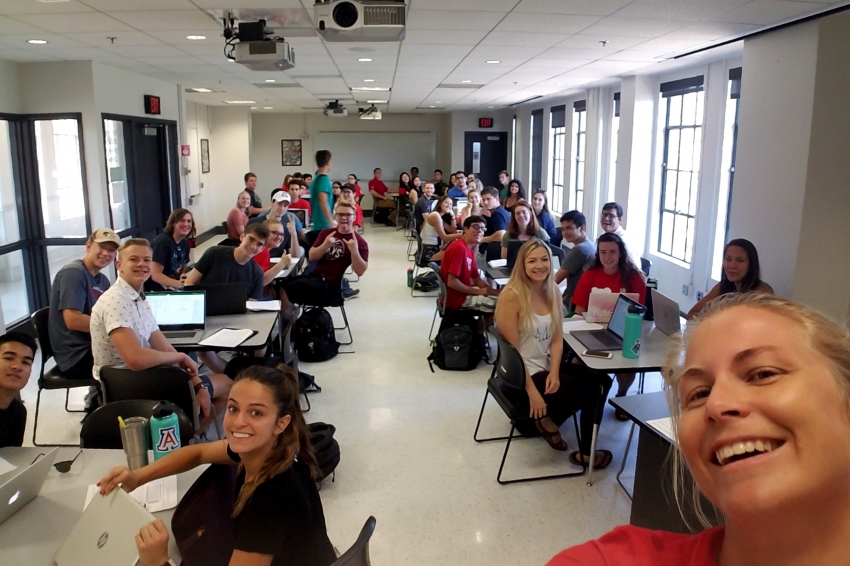
BU staff already focus on the student experience. They do it every day.
The question senior management should be asking is not what more can staff do? It is:
What is preventing staff from providing the experience they want to provide?
If students cannot get enough individual time with academics, look at academic workloads and student-staff ratios. Recent UET changes to programmes and departments planned to decrease staff-student ratios, ensuring insufficient staff to meet student expectations on any given cohort.
If services are slow or difficult to access, it’s because professional services teams have been decimated, reduced to skeleton crews, while their workloads double and triple.
If courses have suffered disruption, look at the impact of losing experienced colleagues without sufficient plans for replacing their expertise and capacity.
If staff cannot give students the time they deserve, look at everything else those staff are being required to fit into the same finite working week.
These are structural problems built by UET. They require structural solutions, not blaming the very people that have been crushed in the last two years. They cannot be fixed by asking individuals to try harder.
Recruitment makes this more urgent, not less
There are undoubtedly significant recruitment pressures that BU cannot control. Higher education is experiencing a serious financial crisis. The recruitment market is difficult, and the Vice-Chancellor notes that higher-tariff institutions have increased their enrolments while institutions such as BU have experienced greater pressure.
But that makes the things BU can control even more important:
- BU can control how it treats its workforce.
- It can control whether departments and services are adequately staffed.
- It can control whether workloads are realistic.
- It can control whether staff have the time and resources necessary to teach, support students, conduct research and provide professional services properly.
- It can control whether major organisational changes are implemented with meaningful consultation, negotiation, communication, and adequate planning.
And it can choose whether to listen when the people actually doing the work tell senior management that something is not working.
Start by removing the obstacles
BU has enormously skilled, experienced and committed staff. They are not the problem to be fixed. The problem is an institutional environment that increasingly obstructs them from doing their jobs as well as they know how to do them.
So if senior management genuinely wants to improve NSS results, student experience, institutional reputation and ultimately recruitment, it needs to stop asking how it can extract still more from the people who remain. Instead, ask staff what is getting in their way.
Then listen to the answers.
Restore capacity. Address workloads. Resource services properly. Give people time to do their jobs. Rebuild the expertise that has been lost. Rebuild trust. And recognise that decisions about staffing and working conditions are also decisions about the student experience.
Because BU cannot spend years reducing the capacity of the people who deliver that experience and then be surprised when students notice.
Our staff know how to deliver an excellent university experience. Give them the conditions in which they can do it.
Some Suggested Reading…
…since it seems UET may not be aware of how crucial staff wellbeing is to student experience:
Bell, Karen. 2022. “Increasing Undergraduate Student Satisfaction in Higher Education: The Importance of Relational Pedagogy.” Journal of Further and Higher Education 46 (4): 490–503. https://doi.org/10.1080/0309877X.2021.1985980.
“sensitive and caring teaching needs to be supported by secure jobs and adequate staffing levels so that teachers have the time and peace of mind to develop these quality relationships [with students]”
Brewster, Liz, Emma Jones, Michael Priestley, Susan J. Wilbraham, Leigh Spanner, and Gareth Hughes. 2022. “‘Look after the Staff and They Would Look after the Students’ Cultures of Wellbeing and Mental Health in the University Setting.” Journal of Further and Higher Education 46 (4): 548–60. https://doi.org/10.1080/0309877X.2021.1986473.
“there is a need to look beyond the provision of reactive services or isolated individual interventions, to proactively and cohesively embed cultural and structural change across the whole institution to support positive wellbeing outcomes for the whole university community”
Hammoudi Halat, Dalal, Abderrezzaq Soltani, Roua Dalli, Lama Alsarraj, and Ahmed Malki. 2023. “Understanding and Fostering Mental Health and Well-Being among University Faculty: A Narrative Review” Journal of Clinical Medicine 12, no. 13: 4425. https://doi.org/10.3390/jcm12134425
Jayman, Michelle, Glazzard, Jonathan, and Rose, Anthea. .2022. “Tipping point: The staff wellbeing crisis in higher education.” Front. Educ. 7:929335. https://doi.org/10.3389/feduc.2022.929335.
“transforming universities into authentically healthy settings requires a sea change in working culture and the higher education environment”
Roos, Brianne H., and Borkoski, Carey C. 2021. “Attending to the Teacher in the Teaching: Prioritizing Faculty Well-Being.” Perspectives of the ASHA Special Interest Groups 6 (4): 831-840. https://doi.org/10.1044/2021_PERSP-21-00006.
“Faculty well-being is important for the individual and in support of scholarship and student outcomes”
Watson, D., R. Webb, and S. Cook. 2025. “Student (Dis)Satisfaction in UK Higher Education: Teaching-Only Contracts, Esteem Uncertainty and Research Intensity.” Studies in Higher Education 50 (11): 2486–2502. https://doi.org/10.1080/03075079.2024.2438843.
“underlining the importance of addressing the esteem-related challenges academic staff face. By incorporating these factors into policy decisions, it’s possible to bolster educational quality and improve student experiences, ensuring that the advantages of teaching specialisation are not undermined by wider institutional practices”
Illegitimi non carborundum.
In solidarity,
BU UCU
Discover more from Bournemouth University University and College Union (BU UCU)
Subscribe to get the latest posts sent to your email.
